Systems Engineering Project 2
Food Printing Systems (Print label)
In this project, I developed an innovative food printing system to improve the customization of print labels. This project showcases my ability to apply systems engineering principles to a real-world problem, demonstrating key skills and innovative thinking.
Objective:
- Analyze a food industry segment using Systems Engineering principles
- Develop a working prototype demonstrating key features and functionality
Industry Focus:
Evebot Food-Grade Portable Printpen: A handheld inkjet printer for customizing food surfaces like macarons, cakes, and coffee.
Why It Matters
This project demonstrates:
- Systems Engineering Application: Ability to analyze, design, and implement complex systems.
- Innovation: Identifying gaps and creating solutions for real-world problems.
- Technical Skills: Proficiency in research, prototyping, and integrating new technologies.
- Inclusivity: Developing accessible solutions for diverse user needs.
Solution Concept
Printing a clear coat over prints made by evebot on food while keeping it food grade and usable
Context
Print labels are pasted on food in groceries for stocks counting and expiry. The purpose of this solution is to replace the label stickers used on fruits with evebot.
Why replace?
Food that was originally ready to eat now requires the stickers to be peeled before consumption. The incorporation of food-safe projects will allow for immediate consumption.
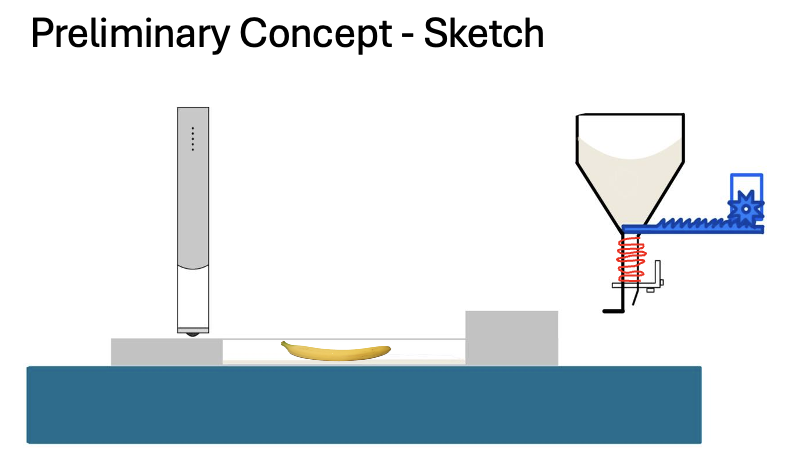
Preliminary sketch of concept
The concept will be Incorporating a printpen to create food safe labels to replace traditional plastic labels, and creating a coating layer using wax to ensure the print does not fade. As wax has to be heated up to liquify, a heating mechanism has to be in place.
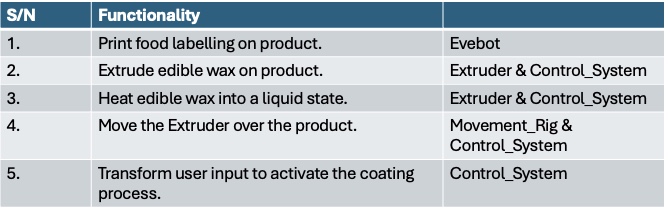
The table above are the functionalities that will be used as the basis for verification. Each functionality is linked to a part of the prototype as showned on the right.
Personal Contributions
- Research Lead: Investigated food printing systems and accessibility solutions.
- Concept Development: Selected and developed the edible clear coat solution.
- Prototype Design: Designed and integrated the extruder mechanism.
Skills and Learning
- Project Management: Constructed Schedule, Cost & Risk Management/Mitigation Plan
- Research and Analysis: Concept selection and exploratory research on 2D food printing systems
- Prototype and Design: Solidworks & Fritzing for schematic diagrams
- Collaboration: Working with groupmates
CAD Drawing of Prototype
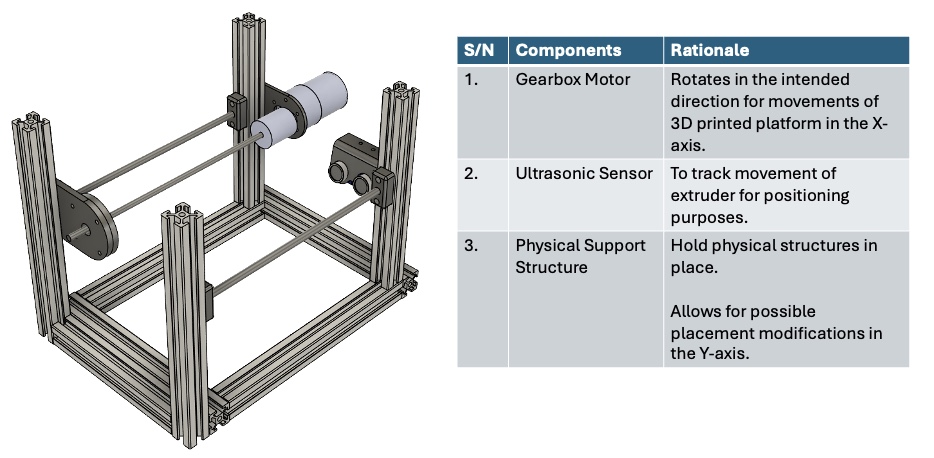
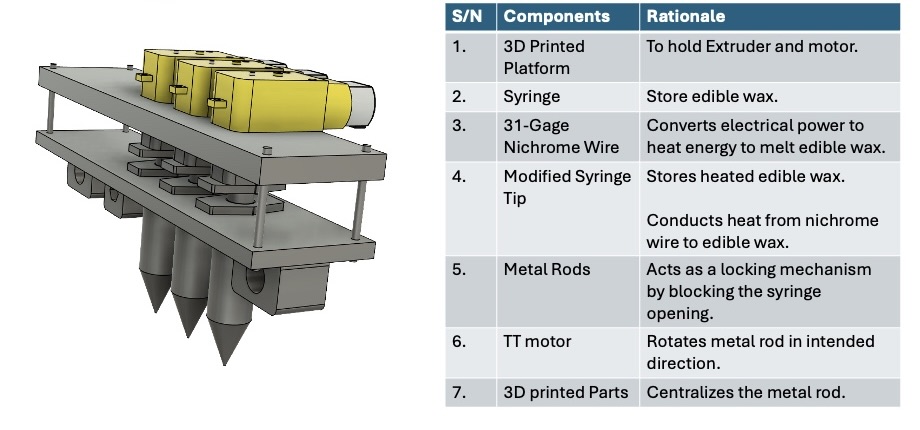
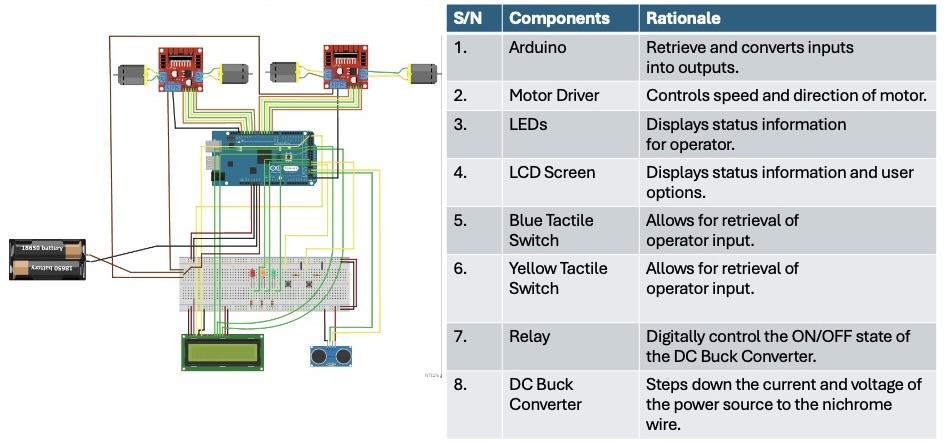
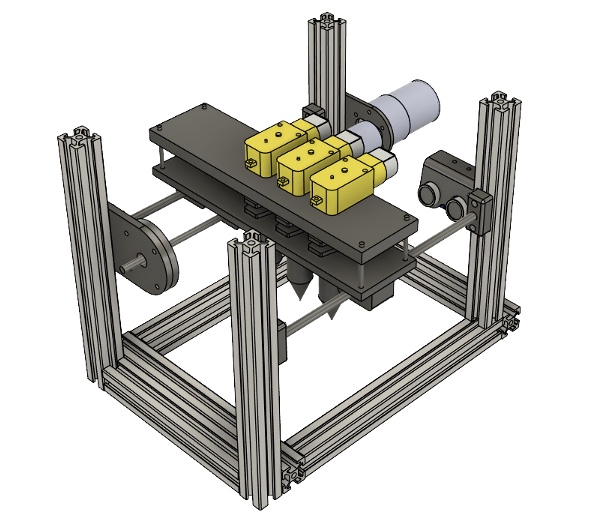
The CAD drawing of the body frame, and the different methods of extrusion was drawn. The above diagrams are CAD drawings for the prototype. It features a movement system with the usage of a 12-volt DC gear-box motor, which will provide rotational torque to move the platform in the X axis. The platform will be used to accommodate the extruder system, which will be required to navigate in the Y axis. The prototype will feature a linear displacement mechanism for extrusion. The extruder will be mounted onto the rod, and the TT motor will be mounted at the top of the syringe, which acts as an opening and closing mechanism for the syringe.
Prototype Showcase
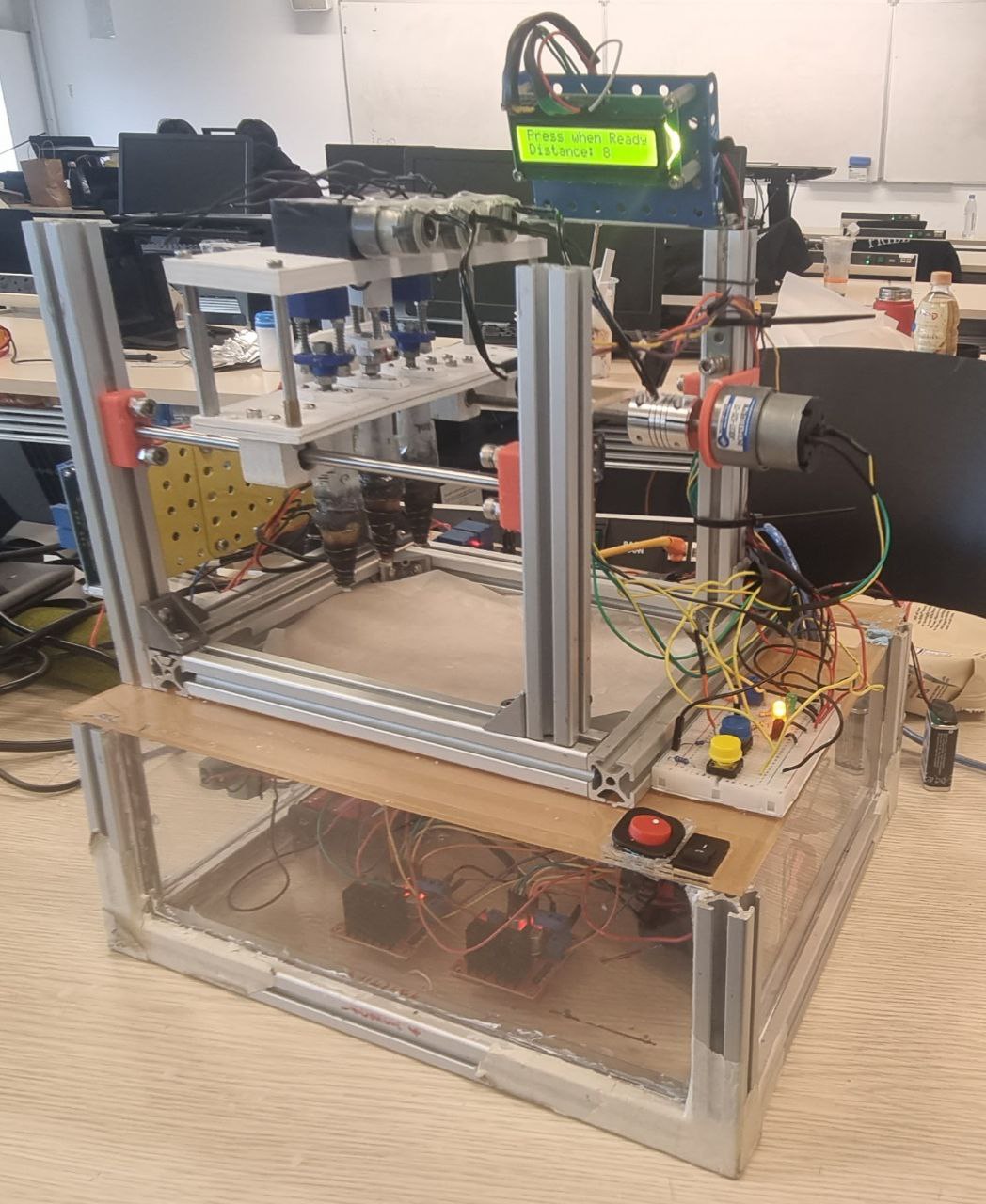
The image above shows the prototype created. There are three extruders in total, mounted atop the rods above ground. The TT motors are mounted onto the extruders to facilitate the opening mechanism for the wax to flow through. As wax is solid at room temperature and requires some heating to be dispensed in liquid form, the step down motors are mounted at the side to help heat the extruder to 400 fahrenheit. The prototype is then validated with different test cases to determine the feasibility of it.
Verification test cases
For each functionality, different test cases were made to verify said functionality
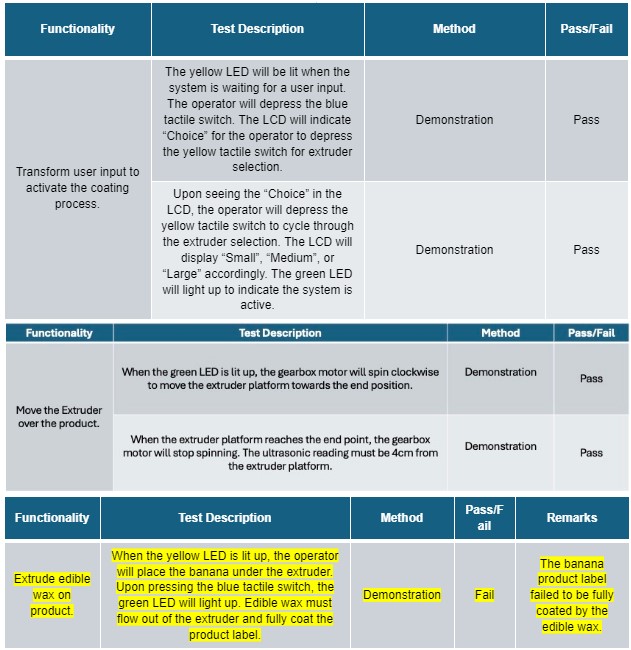
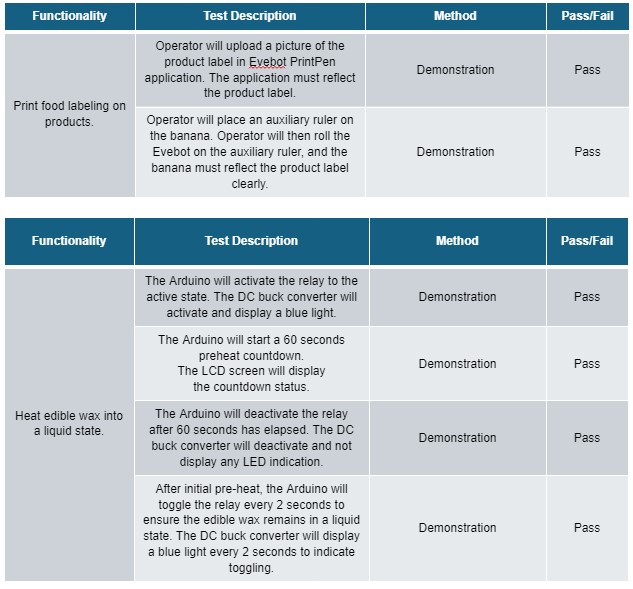
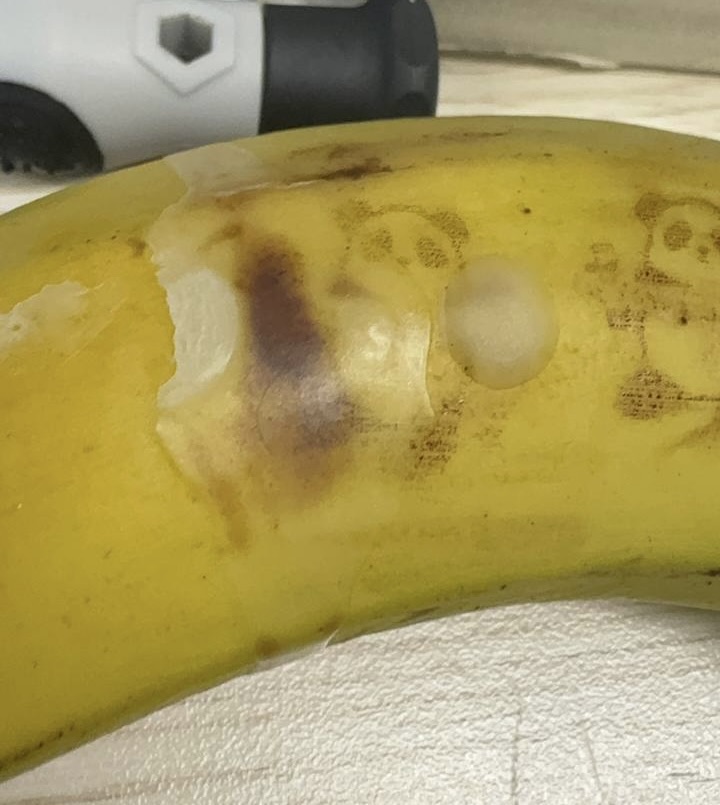
Through the test cases, the functionalities “print food labeling on products”, “heat edible wax into a liquid state”, “transform user input to activate the coating process”, and “move the extruder over the product” were satisfied. The functionality of extruding edible wax on product was not fully satisfied however, as the output failed to be fully coated by the edible wax as shown in the image above. The proof of concept is deemed to be a success, and is ready to proceed to the next phase.
Future Work
Next steps include further testing and refinement of the prototype, user trials, and exploring additional applications of printing food labels. Phase one of this project has concluded, and we can start pitching this idea towards potential stakeholders. For the full detailed report, please refer to this link.